In today’s blog, I will once again be discussing how media’s popularity arises due to its ability to mirror the cultural identities of that society. The media, in this case, will be popular love songs from Korean and Japanese cultures, including “Touch Love” and “Me Me She,” respectively. Because Korea and Japan have different cultures, then subtle differences in popular love songs within their culture will portray that variance. The following chart created by Geert Hofstede was used to determine overall differences in culture:
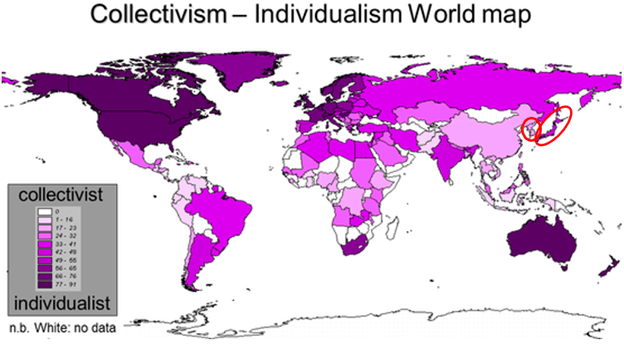
The red circle to the left encompasses Korea whereas the circle to the right comprises Japan. As can be seen, Korea is a lesser shade of purple, which indicates the culture is characterized by greater amounts of collectivism, or interdependence. Using the scale ranging from zero to one hundred, Korea is around 17-23. In comparison, Japan is a darker shade, meaning it has greater amounts of individualism within its culture. However, overall, Japan is a mix of independence and interdependence because the shade places it around 42-48 on the Hofstede scale.
Even if Japan may be almost a perfect mix of independence and interdependence, further research was performed to determine how these coexisted within the culture. A 2018 study by Hashimoto found that Japanese individuals prefer to act independently, but expect others to act interdependently in public settings.2 This may seem tiresome and practically impossible to switch behaviors on and off, but the study found that the participants were successful in doing so.
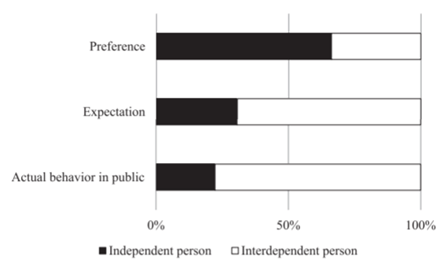
These results from the study show that Japanese individuals are in fact successful in switching their behavior from independent to interdependent when in a public setting.
As such, Japanese media should reflect that unity of interdependence and independence. It should display inklings of individuality, uniqueness, freedom, equality, relations, similarity, and adaptation. Korean media should portray sentiments of solely independence, including individualism, uniqueness, freedom, and equality. Along with my partner Kate, we chose two popular love songs to represent each culture. For Japanese culture, Radwimp’s “Me Me She” from RADWIMPS4 – Okazu no Gohan was used. For Korean culture, Yoon Mi-rae’s “Touch Love” from Master’s Sun OST Part 4 was used.
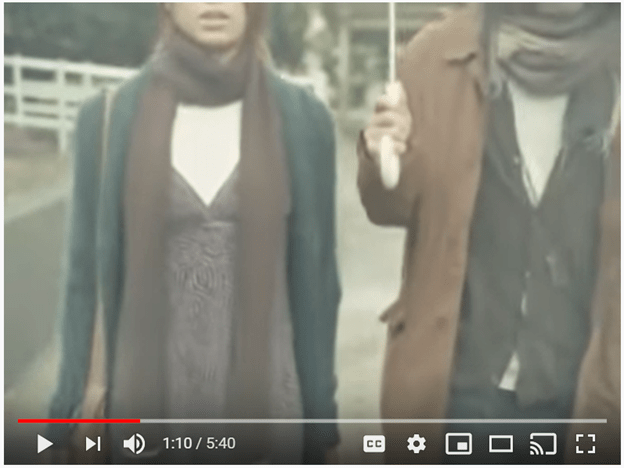
First, I will discuss how the Japanese song (“Me Me She”) displays a combination of independence and interdependence in its music video, lyrics, and title. For the duration of the music video, two people are shown walking side by side with the man holding an umbrella over the woman’s head. Walking together while holding the umbrella over her head ushers in a feeling of care towards the relationship, thus adding the interdependent aspect. However, though this is a love song, they never once hold hands and maintain a respectable difference between each other (Figure 3). This suggests they are independent beings that value relations to others but are not fastened to each other, which could have been indicated by linked arms. In independent cultures, beings are not rooted by others.
In the lyrics, the speaker describes their sense of regret from parting with his girlfriend while also saying how he is thankful for what they had. He will also wait “forever” in case she decides to return. This, then, emphasizes the interdependent part of Japanese culture that focuses on relationships. Rather than move on, the speaker says, “I wanted you to teach me/How to break that promise, how to love someone else/But the truth is that I don’t want to learn at all.”4 This shows how interdependent cultures are rooted in certain relationships. The speaker feels unable to move on because he is rooted by this singular relationship. Unfortunately, that choice is not without consequences. The listener can feel the pain of the speaker in the following lyrics: “Made me shine and made you cloud/Maybe our dreams were too heavy to be placed on this love.”4 This represents how, even if something seems perfect, you cannot force something that was not meant to last forever. In other words, an independent person can make their own choice that may not align with another’s ideals.
Even the title exemplifies the joint presence in the culture, though there is more focus on “me,” which is exemplified by how it is in the title twice, compared to others, or “she.” This would make sense according to the 2018 study because Japanese prefer independence and only rely on interdependence in social settings, thus they are more likely to gravitate towards a song with greater remnants of independence. An individual’s preference for a song is highly reflective of the culture. In this song, there are greater linkages towards independence, which is the Japanese preference, over the socially expected interdependence.
Second, I will discuss how the Korean song (“Touch Love”) displays inner workings of an interdependent culture in its music video, lyrics, and title. In the music video, it is instantly noticeable that this culture, in comparison to Japan, places greater emphasis on interconnectedness to others. Whereas the “Me Me She” video never showed a physical embrace, this song does not shy away from it. An example is shown below (Figure 4). Showing the two individuals in an embrace emphasizes a union of individuals, which is a key element to interdependent cultures.

A second key feature in the music video that sheds light onto the interdependent aspect of Korean culture is how it includes faces (Figure 5). Faces are essential for forming and nurturing friendships.6 A 2016 study led by Robin Dunbar noted that online friendships caused social bonds to be lackluster compared to friendships involving large amounts of face-to-face contact.6 As such, an independent culture that does hold relations to others as paramount to well-being would not be as likely to include this in their music video, which is why Japan’s love song representative (“Me Me She”) did not include faces. It makes sense that an interdependent culture, such as Korea, would include this element. The difference here is also useful for displaying how belongingness and love needs (an etic), which is part of Maslow’s hierarchy of needs, can give rise to varied manifestations across cultures. To fulfill this natural human need, Korean’s culture is defined more by physical touch than Japanese culture. Essentially, within the etic, there are culture-specifics, or emics.
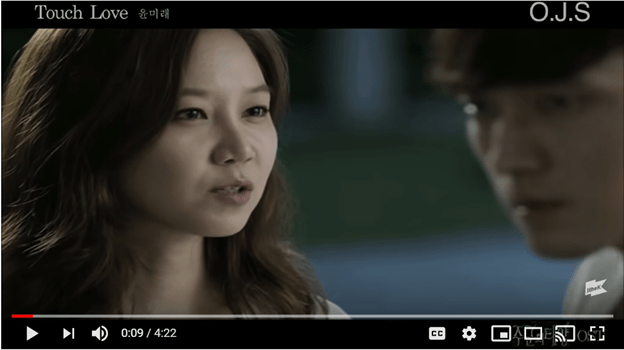
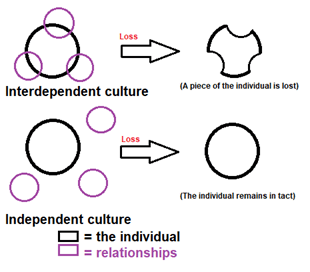
Additionally, both the lyrics and title continue to emphasize the interdependence of Korea. The lyrics “Yes I love you like my fate” are particularly important because it shows how the speaker considers their relationship with the other individual to be part of their future.7 In interdependent cultures, removing a friendship is like removing a part of the individual themselves, as is illustrated below (Figure 6). Interdependent cultures, such as Korea, are more likely to envision a future with others because relationships partially comprise the individual.
The final factor that emphasizes the difference in Japanese to Korean culture is the title of “Touch Love.” When compared to the Japanese music video that presented minimal touch between the two individuals, it is instantly clear from this title, going so far as to include it in the title, is starkly different. Touch symbolizes a physical joining of beings, and love creates an emotional connection. The title “Touch Love” essentially includes two forms of connection, meaning this song garnered popularity in Korea because the culture is characterized by relations to others.
Above all, I thoroughly enjoyed gathering information about these cultures. Honestly, I have minimal knowledge about cultures on the far East of Asia, so I am glad this project led me to better understand a culture vastly different from my own.
References
1 “The 6 Dimensions Model of National Culture by Geert Hofstede.” Geert Hofstede, geerthofstede.com/culture-geert-hofstede-gert-jan-hofstede/6d-model-of-national-culture/.
2 Hashimoto, Hirofumi. “Interdependence in a Japanese cultural context: Distinguishing between preferences and expectations.” The Japanese Journal of Experimental. DOI: 10.2130/jjesp.1815. https://www.jstage.jst.go.jp/article/jjesp/advpub/0/advpub_1815/_pdf
3 Radwimpsstaff. “Me Me She RADWIMPS MV.” YouTube. 30 June 2009, https://www.youtube.com/watch?v=wvvItrHEfRA.
4 “Me Me She.” Anime Lyrics. https://www.animelyrics.com/jpop/radwimps/memeshe.htm.
5 1theK. “[MV] t Yoonmirae(t 윤미래) _ Touch love (터치 러브) (Master`s sun(주군의 태양) OST Part 4).” YouTube. 27 Aug. 2013, https://www.youtube.com/watch?v=ZH8BYNwmR5Q.
6 Bergland, Christopher. “Maintaining Close Friendships Requires Face-to FaceContact.” Psychology Today, Sussex Publishers, 19 Jan. 2016, https://www.psychologytoday.com/us/blog/the-athletes-way/201601/maintaining-close-friendships-requires-face-face-contact.
7 “Touch Love – Yoon Mirae Lyrics [Romanized, English, Hangul].” Kpop God, 6 Sept. 2013, https://kpopgod.wordpress.com/2013/09/06/touch-love-yoon-mirae-lyrics-romanized-english-hangul/
 Adria's Music Blog